
Last week at the park, I watched a toddler stand at the edge of the sandbox, holding a toy truck, watching two kids build a tower together. She wanted to join. I could see it in her eyes. But she didn’t know how. So she stood there, quiet, unsure, until the moment passed. If you’ve ever watched your child want to connect but not know how, you know that mix of hope and heartache. Watching your toddler stand quietly at the edge of the playground can tug at your heart in unexpected ways.
While other children laugh together, your little one clings to your leg, watches from a distance, or happily plays alone. You may wonder, “Why won’t my toddler make friends? Is something wrong? Am I doing enough?”
If these thoughts sound familiar, you’re not alone.
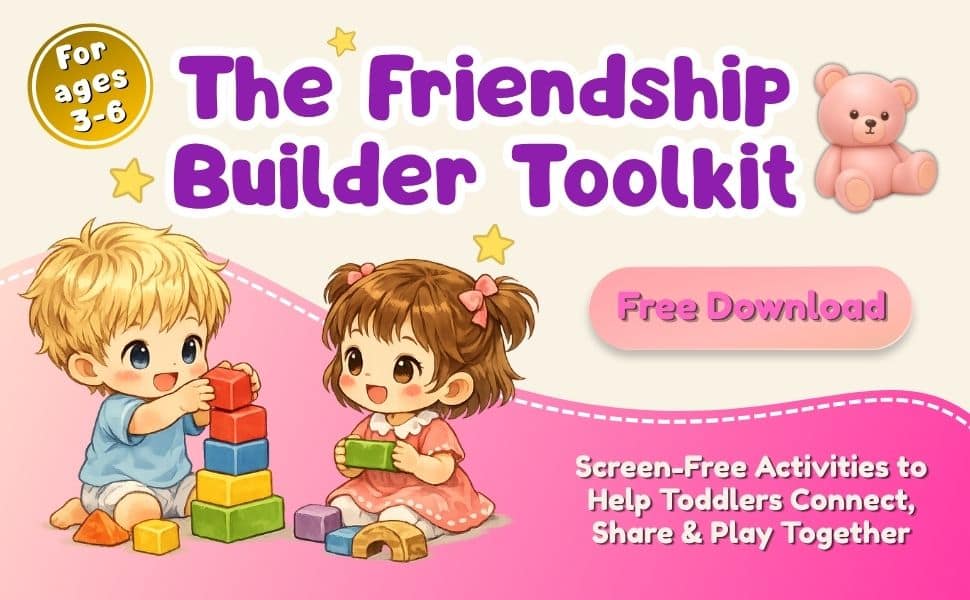
Many parents search for how to help a toddler make friends because they worry that their child is falling behind socially. If you’ve been wondering how to help a toddler make friends, you’re not alone. But here’s the reassuring truth: friendship isn’t a milestone that children suddenly reach. It’s a skill that develops gradually through hundreds of small, meaningful interactions.
Just as toddlers don’t learn to run in a single day, they don’t learn to build friendships overnight. They first develop emotional security, confidence, communication skills, empathy, and the ability to handle minor social disappointments. These invisible building blocks are what eventually grow into lasting friendships.
The good news is that you don’t need to turn your child into the loudest or most outgoing toddler in the room. Your role isn’t to collect playdates or push constant social interaction. Instead, your job is to create the conditions where social confidence can naturally grow. Once you understand how to help a toddler make friends, you’ll see that building these emotional skills matters far more than encouraging quick friendships.
In this guide, you’ll discover why some toddlers struggle to connect, what most parenting advice gets wrong, and a simple framework that helps children develop the emotional foundations of genuine friendship—one small step at a time.
Start with these three simple strategies today:
- Don’t rush them into play. Give your toddler a few minutes to watch other children first. Observation helps many toddlers feel safe before joining in.
- Choose familiar places. Visiting the same playground or playgroup each week helps children recognize familiar faces and feel more confident.
- Praise small social wins. Celebrate simple moments like saying “hi,” sharing a toy, or taking turns. These tiny successes build lasting confidence.
Why Some Toddlers Find Friendship Difficult: how to help a toddler make friends
Before learning how to help a toddler make friends, it’s important to understand what friendship actually looks like in early childhood.
Adults often imagine friendship as children happily sharing toys, talking together, and playing cooperative games. Developmentally, however, toddlers are still learning these skills.
Most children under the age of four are just beginning to understand that other people have different thoughts, feelings, and desires. This ability—called perspective-taking—is still developing. That’s why your toddler may grab a toy, walk away during a game, or seem uninterested in joining other children. These behaviors are often signs of normal development rather than poor social skills.
Friendship begins long before children call someone their “best friend.”
It begins with feeling safe.
Your 30-Day Friendship Confidence Plan: how to help a toddler make friends
Week 1: Build Emotional Safety
Visit one familiar playground twice.
Practice turn-taking games at home.
Read stories about kindness and friendship.
Goal: Your child feels comfortable in familiar settings.
Week 2: Encourage Small Interactions
Smile at familiar children.
Practice saying “Hi.”
Play alongside other children without pressure.
Goal: Two or three positive social moments.
Week 3: Strengthen Cooperative Play
Build something together.
Complete a simple puzzle with another child.
Encourage pretend play.
Goal: Five minutes of cooperative play.
Week 4: Build Independence
Let your child solve simple social challenges.
Celebrate effort rather than outcomes.
Continue visiting familiar places.
Goal: Notice increased confidence, curiosity, and willingness to engage.
Common Mistakes That Make Friendship Harder: how to help a toddler make friends
1. Comparing Your Child to Others
Mistake: Comparing your toddler with more outgoing children.
Why it hurts: Comparison increases your anxiety, and children often pick up on that pressure.
Do this instead: Compare your child’s progress to where they were a few weeks ago—not to someone else.
2. Forcing Social Interaction
Mistake: Pushing your toddler to join every game or say hello.
Why it hurts: Pressure can make shy children even more reluctant.
Do this instead: Invite participation, but let your child join when they feel ready.
3. Solving Every Conflict
Mistake: Stepping in at the first sign of disagreement.
Why it hurts: Your toddler misses valuable opportunities to learn problem-solving and resilience.
Do this instead: Coach from the sidelines and only intervene when necessary.
4. Expecting Instant Friendships
Mistake: Hoping one playdate will create a best friend.
Why it hurts: Friendships take time, and unrealistic expectations can lead to frustration.
Do this instead: Celebrate small social wins and trust the process.
5. Overloading the Schedule
Mistake: Filling every week with activities and playdates.
Why it hurts: Overtired toddlers often struggle to engage with others.
Do this instead: Balance social opportunities with plenty of free play and rest.
6. Labeling Your Child
Mistake: Saying, “She’s shy” or “He’s not social.”
Why it hurts: Children can begin to believe these labels define them.
Do this instead: Use growth-focused language, such as “She likes to watch before joining.”

Friendship Is Learned Through Play: How to help a toddler make friends
Young children rarely build friendships by talking. They build friendships through shared experiences. Rolling a ball back and forth. Building towers together. Pretending to cook. Drawing with sidewalk chalk. Digging in the sand. These activities create what psychologists call joint attention—two children focusing on the same experience together. Joint attention is one of the earliest foundations of social connection.
The conversation comes later. The connection comes first
The Psychology Behind Toddler Friendships: How to help a toddler make friends
Children build relationships from the inside out. A toddler who feels emotionally secure is more likely to:
- smile at another child
- copy another child’s play
- share attention
- recover after disagreements
- Try again after rejection
By contrast, a child who feels overwhelmed or uncertain often protects themselves by withdrawing, clinging to a parent, or avoiding interaction altogether. This isn’t because they don’t want friends. It’s because their brain is prioritizing safety over connection. Think of friendship as a house. Parents often focus on decorating the rooms, teaching sharing, saying “please,” or arranging playdates. But houses don’t stand because of beautiful furniture. They stand because of strong foundations. Emotional safety is that foundation.
The CONNECT Framework– How to help a toddler make friends
The CONNECT Framework™ provides a simple, memorable system that helps toddlers build lasting social confidence from the inside out.
Rather than pushing children into friendships, each step strengthens an essential emotional skill that makes friendship happen naturally.
C — Create Emotional Safety
Children connect best when they feel secure. Before expecting your toddler to play with others, make sure they feel comfortable in the environment. Arrive early at the playground. Stay nearby while they explore. Offer calm reassurance without rushing them. When children know they have a safe base to return to, they’re far more willing to take social risks.
O — Observe Before Joining
Give your toddler permission to watch. Observation isn’t avoidance. It’s preparation. Instead of saying,
“Go play.”
Try saying,
“Let’s watch what game they’re playing.”
This simple change removes pressure while encouraging curiosity. Many toddlers naturally join after watching for a few minutes.
N — Nurture Small Social Wins
Confidence grows through tiny successes.
Celebrate moments such as:
- making eye contact
- smiling at another child
- handing over a toy
- saying “hello”
- Taking one turn during a game
Each small success teaches your toddler:
“I can do this.”
These micro-victories gradually become lasting confidence.
N — Normalize Big Feelings
Friendships include disappointment. Children get left out. Games end. Someone says “no.” Instead of fixing every situation, help your toddler name the feeling.
You might say:
“That felt disappointing. You really wanted to play.”
When children learn that difficult emotions are manageable, they become more willing to try again instead of giving up.
E — Encourage Cooperative Play
Cooperative activities naturally create conversation. Choose games where children work toward a shared goal rather than compete.
Examples include:
- building a block tower together
- completing a simple puzzle
- pretend cooking
- treasure hunts
- watering plants
- creating art together
Working side by side feels less intimidating than direct conversation. Friendship often begins through shared purpose.
C — Coach Instead of Controlling
Think of yourself as a guide rather than a referee. Instead of solving every disagreement, ask gentle coaching questions.
“What could you say?”
“How do you think she feels?”
“What could we try next?”
These moments strengthen problem-solving, empathy, and emotional regulation—skills that last far beyond the playground.
T — Trust the Process
Perhaps the most important step is also the hardest. Friendship isn’t built in a weekend. It’s built through hundreds of ordinary moments.
A smile today.
A shared toy tomorrow.
A five-minute game next week.
Each interaction adds another brick to your child’s social confidence. The goal isn’t raising the most popular child.
It’s raising a child who feels confident, kind, emotionally secure, and capable of forming meaningful relationships wherever life takes them.
Putting the CONNECT Framework™ into Action– How to help a toddler make friends
Knowing how to help a toddler make friends is only the first step. The real progress comes from small, consistent actions. Here are five simple ways to put the CONNECT Framework™ into practice.
1. Create Safe Opportunities for Play
Choose familiar places like the same playground, library story time, or a small playgroup. Familiar environments help toddlers feel secure, making them more likely to interact with other children.
2. Model Friendly Behaviour
Your toddler learns by watching you. Smile, greet other parents, say “thank you,” and model kindness. Seeing positive social interactions teaches children how friendships begin.
3. Practice Social Skills at Home
Build friendship skills through everyday play. Take turns rolling a ball, build block towers together, enjoy pretend play, or role-play simple playground situations. These activities teach cooperation in a relaxed setting.
4. Coach Instead of Rescuing
When your child faces a small social challenge, guide them instead of solving it. Ask questions like, “Would you like to ask for a turn?” This builds confidence and problem-solving skills.
5. Celebrate Small Social Wins
Praise effort rather than results. A smile, sharing a toy, or taking turns are all important milestones. Instead of asking, “Did you make a friend today?” ask, “What was your favorite game today?” This encourages confidence without adding pressure.
The Hidden Mistakes Parents Make– How to help a toddler make friends
Parents naturally want to help. Unfortunately, some well-meaning strategies accidentally make friendship harder.
Mistake 1: Becoming the Social Director
Many parents constantly tell their toddler:
“Go ask if you can play.”
“Say hello.”
“Share your toys.”
“Go make a friend.”
Although these instructions seem helpful, they can overwhelm a child who is already feeling uncertain. Instead of developing social confidence, they begin to rely on adults to manage every interaction.
Mistake 2: Rescuing Too Quickly
Imagine your toddler reaches for a toy, and another child says, “No.” Before your child has a chance to respond, you step in immediately. While this feels protective, it removes an important learning opportunity. Small social disappointments teach resilience. Children gradually learn that disagreements don’t end friendships. They simply become part of learning how relationships work.
Mistake 3: Measuring Success by the Number of Friends
Friendship isn’t a popularity contest. One meaningful interaction teaches more social skills than ten rushed introductions. Parents often focus on quantity. Healthy development focuses on quality.
What Early Childhood Experts Want Parents to Know about How to help a toddler make friends
Parents often worry that their toddler isn’t making friends fast enough. But early childhood educators and child development experts emphasize that friendship is a process—not a race.
Child Development Experts: Strong Relationships Start at Home
Researchers at the Harvard University Centre on the Developing Child explain that responsive back-and-forth interactions between children and caring adults—often called “serve and return”—help build the brain circuits that support communication, emotional regulation, and future social skills.
Early Childhood Teachers: Play Matters More Than Popularity
Preschool teachers often notice that children don’t become friends simply because they’re placed in the same classroom. Friendships usually grow through repeated opportunities to play together, solve small problems, and share enjoyable experiences. National Association for the Education of Young Children (NAEYC)
Advanced Insights about How to help a toddler make friends
1. Friendship Begins Before Conversation
Many parents assume talking creates friendship. For toddlers, shared experiences matter far more. Two children pushing toy trucks side by side may barely speak—but they are already learning cooperation, observation, and trust. Connection often begins silently.
2. Repetition Builds Confidence
Social confidence doesn’t grow from one successful playdate. It grows from predictable experiences. Children who regularly visit familiar parks, classes, or libraries begin recognizing faces. Recognition creates comfort. Comfort creates interaction. Interaction gradually becomes friendship. Consistency matters more than variety.
Final Thoughts: help a toddler make friends
Helping your toddler build friendships isn’t about making them more outgoing. It’s about raising a child who feels emotionally safe, confident, and connected. Some children run toward new friends. Others watch quietly before taking that first brave step. Both paths are completely valid. Every smile, every shared toy, every small conversation is another brick in the foundation of lifelong relationships. Remember the image of the tree. You can’t pull on its branches to make it grow faster. You water the roots. When you nurture emotional security, empathy, confidence, and joyful play, friendships become the natural blossoms that follow.
Ready to help your child grow socially through play?
Explore our collection of screen-free activities, printable friendship games, and bedtime stories designed to nurture kindness, empathy, confidence, and emotional resilience—one meaningful moment at a time.
[How to Handle Toddler Big Feelings Without Meltdowns]
because social skills start with emotional skills.
Read Bedtime story about left out which help a toddler make friends
Affu and the Empty Spot: A Heartwarming story about being left out
At what age do toddlers start making friends?
Most toddlers begin showing interest in playing with peers between 2 and 3 years old, while more cooperative friendships usually develop between 3 and 5 years as language, empathy, and emotional regulation mature. If you’re wondering how to help a toddler make friends, remember that every child develops social skills at their own pace.
Is it normal for my toddler to play alone?
Yes. Independent play is a healthy part of development. Many toddlers naturally alternate between playing alone and interacting with others as they build confidence. Knowing how to help a toddler make friends means understanding that solo play is often an important step toward future friendships.
How can I help my shy toddler socialize?
Start with familiar environments, avoid pressuring your child, model friendly behaviour, and celebrate small social successes. If you’re learning how to help a toddler make friends, focus on building confidence through positive experiences rather than forcing interactions.
Should I arrange more playdates?
Not necessarily. Quality matters more than quantity. A few regular playdates with familiar children are usually more beneficial than constantly introducing new people. One of the best ways how to help a toddler make friends is to create consistent opportunities for comfortable, low-pressure social play.
When should I seek professional advice?
Talk to your paediatrician if your child consistently avoids eye contact, shows little interest in interacting with people, loses previously learned social skills, or has broader developmental concerns. While many children simply need time and encouragement, seeking professional guidance can help if you’re concerned about how to help a toddler make friends or your child’s overall social development.
Leave a Reply