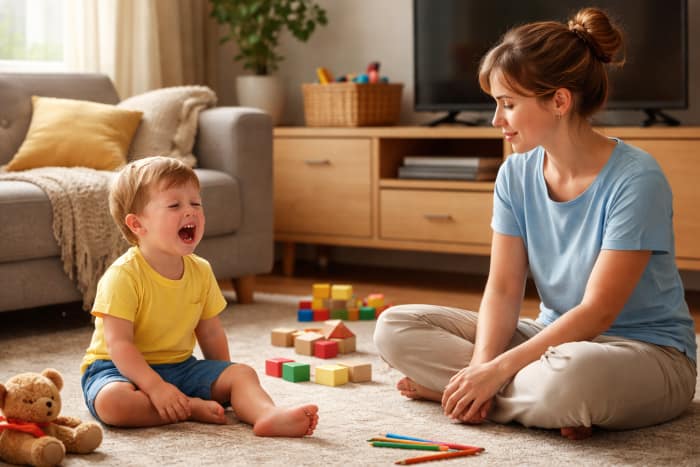
You say “time to turn it off…” and suddenly your sweet toddler becomes a screaming, flailing puddle on the floor.
If this feels painfully familiar, you’re not alone. Screen time tantrums are now one of the most common behaviour challenges reported by parents and early childhood educators.
The good news? It isn’t bad parenting. And it’s absolutely fixable.
Recent child development research shows these meltdowns are rooted in how toddler brains process stimulation, transitions, and emotional regulation—not defiance.
Let’s break down why screen time tantrums happen and what actually helps.

Why Screen Time Tantrums Happen in Toddlers — Research-Driven, Not Just Opinion
Multiple lines of scientific evidence explain what’s happening at the neural and behavioral levels, as described in Screen Time Tantrums in Toddlers.
1. Fast-Paced Screens Trigger the Brain’s Reward System (Dopamine Loop)
Digital screens, especially fast-paced videos and games, trigger the brain’s dopamine pathways, reinforcing pleasurable activities. When toddlers experience quick visual rewards, their brains release dopamine, creating immediate pleasure. However, when screens are turned off, they face a sudden drop in dopamine, leading to frustration and emotional dysregulation.
2. Emotional Regulation Skills Are Still Under Construction
Toddlers lack a fully developed ability to self-soothe, as key brain areas involved in emotion regulation, especially the prefrontal cortex, are still immature. This brain region is crucial for impulse control and managing reactions—skills that toddlers have yet to acquire.
3. Transitions Are Hard for Toddlers—Especially Abrupt Ones
Transitions between activities can be challenging for toddlers. Abrupt endings to screen time leave little time for adjustment, often resulting in adverse reactions in their still-developing brains.
4. Emotional and Behavioral Patterns May Be Reinforced Over Time
Using screens to soothe emotional distress can create a dependency, hindering natural self-regulation skills and leading to increased tantrums. While screens have educational benefits, relying on them for coping can train the brain to seek external stimulation.
5. Screen Time May Influence Broader Emotional and Behavioral Outcomes
Research shows that increased screen time in early childhood is linked to a higher risk of emotional and behavioral issues later, including frustration tolerance and social-emotional challenges. Excessive screen time is associated with greater difficulties and reduced self-regulation.
Child Self-Regulation Development Research (Harvard Center on the Developing Child)
How screens affect toddler behavior(NIH / PubMed article)
Screen Time Tantrums in Toddlers: The Step-by-Step Fix for Parents and Teachers
Section 1 — The 30-Second Fix You Can Use Today
“If you’re about to turn off the TV and you’re already bracing for a meltdown — do this first.”
Say calmly:
“One more minute, then we say bye-bye show.”
Then:
- Wave goodbye to the screen together
- Count slowly from 10 to 1
That’s it. No lecture. No rush. Just this small ritual.
You’ll notice the reaction is already softer.
Section 2 — The Screen Ending Routine (Core Solution)
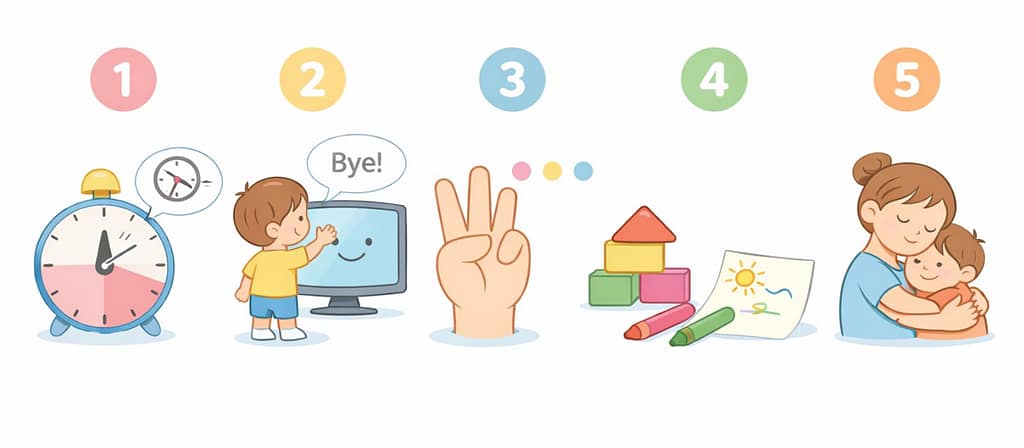
The 5-Step Screen Ending Routine That Stops Screen Time Tantrums
Use this every single time. Consistency is the secret.
- Preview before starting
“You can watch one show. When it ends, we turn it off.” - Use a visual timer
Let them see time running out. - Do a transition ritual
Wave, sing a tiny “bye-bye” song, or count down. - Have the next activity ready
Don’t figure this out after turning it off. - Reconnect
Smile, hug, eye contact: “Let’s go play!”
This routine becomes familiar. Familiar means safe. Safe means fewer screen Time tantrums.
Section 3 — What To Do When the Screen Time Tantrum Has Already Started
What To Do During a Screen Time Tantrum (Do Not Skip)
When the crying starts:
- Don’t explain
- Don’t argue
- Don’t distract with another screen
Instead:
- Sit nearby, calm and quiet
- Say one line: “I’m here. You’re safe.”
- Wait
Your calm helps their brain calm down. Words don’t.
Section 4 — Why Your Current Method Is Making It Worse
Common mistakes that trigger screen time tantrums
- Saying “last video” without warning at the start
- Turning the TV off suddenly
- Giving screens before nap, meals, or school
- Turning off the screen and immediately asking them to do something difficult
These feel small to adults. They feel huge to toddlers.
Section 5 — How to Prevent Screen Time Tantrums Before They Start
Best times for screens
- After nap
- After snack
- When they’re already calm
Worst times for screens
- Before sleep
- Before school
- When they’re hungry or tired
Duration rule
30–45 minutes at a time is plenty
Type of shows
Choose slower, calmer programs. Fast cartoons make transitions harder. Tips for handling screen time tantrums(HealthyChildren.org)
Section 6 — In Classrooms: How Teachers Can End Screen Time Without Chaos
This works beautifully in preschools and daycares.
- Never go from screen → circle time.
- Do 3 minutes of jumping, stretching, or dancing first
- Use a visual schedule so children know what comes next
- Do a group countdown: “10…9…8…”
The whole class follows the same ritual. Fewer meltdowns, smoother flow.
American Academy of Pediatrics screen time guidelines-HealthyChildren.org (AAP)

Section 7 — What To Offer Immediately After Screen Time
Toddlers don’t handle “nothing” well. Offer something simple right away:
- Playdough
- Water play in a bowl
- Stickers
- Blocks
- Snack time
- Coloring pages
- Sensory bin
- Puzzles
- Picture books
- Toy cars or dolls
Printable screen ending activity pages– Affu’s Little World Kid Activity Zone
Picture book and Colouring book to reduce screen time tantrums– Affu’s Little World Book Store
FAQs About Screen Time Tantrums in Toddlers
Why does my toddler have a tantrum when I turn off the TV?
Fast, colorful shows overstimulate the brain’s reward system. When the screen turns off, there’s a sudden drop in stimulation, and toddlers don’t yet have the self-control skills to handle that shift calmly.
Are screen time tantrums normal?
Yes. They’re common in toddlers because transitions are complex and emotional regulation is still developing. It’s a brain-development issue, not bad behaviour.
How long should screen time be to avoid tantrums?
Keep it to 30–45 minutes at a time and avoid screens before naps, meals, or school. Short, well-timed sessions lead to smoother endings.
What is the best way to end screen time without a meltdown?
Give a warning before starting, use a visual timer, do a small goodbye ritual (wave or countdown), and have the next activity ready immediately.
Should I obliterate screens?
Not necessary. Consistent routines and gentle transitions work better than banning screens.
What should I do if the tantrum has already started?
Stay calm, sit nearby, say one comforting phrase like “I’m here,” and wait. Avoid lecturing or negotiating in that moment.
Do these strategies work in classrooms, too?
Yes. Teachers use countdowns, visual schedules, and a brief movement break after screen time to prevent group meltdowns.
What activities can easily replace screen time?
Simple options like playdough, coloring, stickers, water play, blocks, puzzles, or snack time help toddlers shift attention without stress.
Leave a Reply